
Resilience is what turns purpose into lasting impact
The organisations that sustain their mission are rarely the ones with the most funding. They are the ones that have built the right foundations — governance that holds, finances that endure, people who stay, and strategy that has room to think. We help you build that resilience, and we measure it with a single number: the Mission Resilience Index.
Organisational and financial resilience — so you can sustain and grow your mission for the long term.
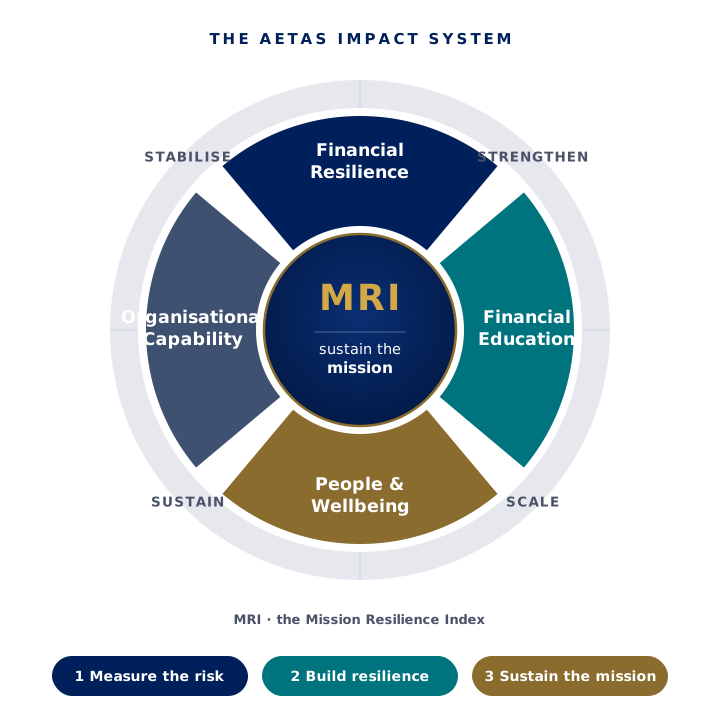
The Aetas Impact System — one operating model, four drivers, one measure.
The Mission Resilience Index (MRI) — a benchmarked score you can track and report.
Measure the risk.
Build resilience.
Sustain the mission.
Three disciplines, applied in sequence, on every engagement. It is the spine of everything Aetas Impact does — and the reason nothing is recommended before the risk is measured.
The Aetas Impact System
Everything below is one system. A mission-impact core, measured by the MRI; four drivers that build resilience; and a journey every organisation travels as it grows stronger.
Three stages, one repeatable method
Measure the risk
Every engagement begins with the Impact Review — a structured, no-cost diagnostic across all four drivers. It produces your baseline Mission Resilience Index and a written summary suitable for trustees.
Build resilience
We deploy only the drivers the diagnosis calls for. Each intervention is chosen to close a specific resilience gap, agreed in writing, and introduced in proportion to the organisation and its budget.
Sustain the mission
We re-measure the MRI, embed resilience as a habit, and report it in a format built for boards and funders — so the organisation keeps delivering its mission, year after year, through whatever comes.
The four drivers of resilience
Resilience is not one thing. It is built across four drivers, each answering one of the pressures that quietly limit impact. Services are no longer standalone offers — they are the instruments through which each driver is strengthened.
Financial Resilience
Reserves, income diversification, financial planning and stronger day-to-day financial decision-making. The capacity to absorb shocks and sustain delivery when funding tightens.
Financial Education
Practical financial education and guidance for trustees, leaders, employees and volunteers — so the people who steer the organisation make confident, well-informed financial decisions.
People & Wellbeing
Financial and workplace wellbeing, leadership support and healthier cultures that keep staff and volunteers motivated and retained. Where charities are assessed as employers, we apply Return on Employee Investment (ROEI) as one specialist diagnostic within this driver.
Organisational Capability
Structures, planning, partnerships and operational effectiveness — so the organisation can keep delivering its mission sustainably as it grows.
What about governance? Strong governance is essential to resilience — but Aetas is not a governance consultancy. Where the Impact Review surfaces governance, legal or regulatory risk, we highlight it, explain why it matters, recommend improvements and introduce trusted specialists. Governance strengthens the System; it is not something we claim to deliver ourselves.
The Mission Resilience Index
ROEI is the proprietary measure of Aetas Performance. Aetas Impact has its own: the Mission Resilience Index — a single, benchmarked score, from 0 to 100, across the four drivers. It is what makes resilience visible, comparable and reportable.
Baselined
Established at the Impact Review, before anything is recommended.
Benchmarked
Scored against comparable organisations — a growing sector dataset only Aetas holds.
Tracked
Re-scored over time, so improvement is evidenced rather than asserted.
Board-ready
A number trustees and funders understand, in a format built for reporting.
The Mission Resilience Index is the foundation of a long-term data moat — the basis for annual reviews, sector benchmarking and, in time, an Aetas resilience accreditation.
Where the system takes you
Resilience is a maturity curve, not a one-off project. The System meets an organisation where it is and moves it forward, one stage at a time.
Stabilise
Relieve the immediate pressures and remove avoidable risk. Steady the foundations.
Strengthen
Close the resilience gaps the MRI reveals across finances, financial education, people and organisational capability.
Scale
Grow delivery on foundations that can carry the weight, without new fragility.
Sustain
Embed resilience as a habit — measured, reviewed and reported year after year.
Five principles
Everything is measurable.
If it affects resilience, it can be assessed, scored and tracked.
Every intervention strengthens resilience.
Nothing is introduced without a clear resilience purpose.
Solve the cause, not the symptom.
We treat the underlying weakness, not its visible effects.
Resilience is proven, not assumed.
Improvement is evidenced with the MRI, not asserted.
Resilience serves the mission.
A stronger organisation is never the goal in itself — greater impact is.
Start with an Impact Review
A structured, no-cost diagnostic that produces your baseline Mission Resilience Index. No obligation. A written summary your board can act on.